

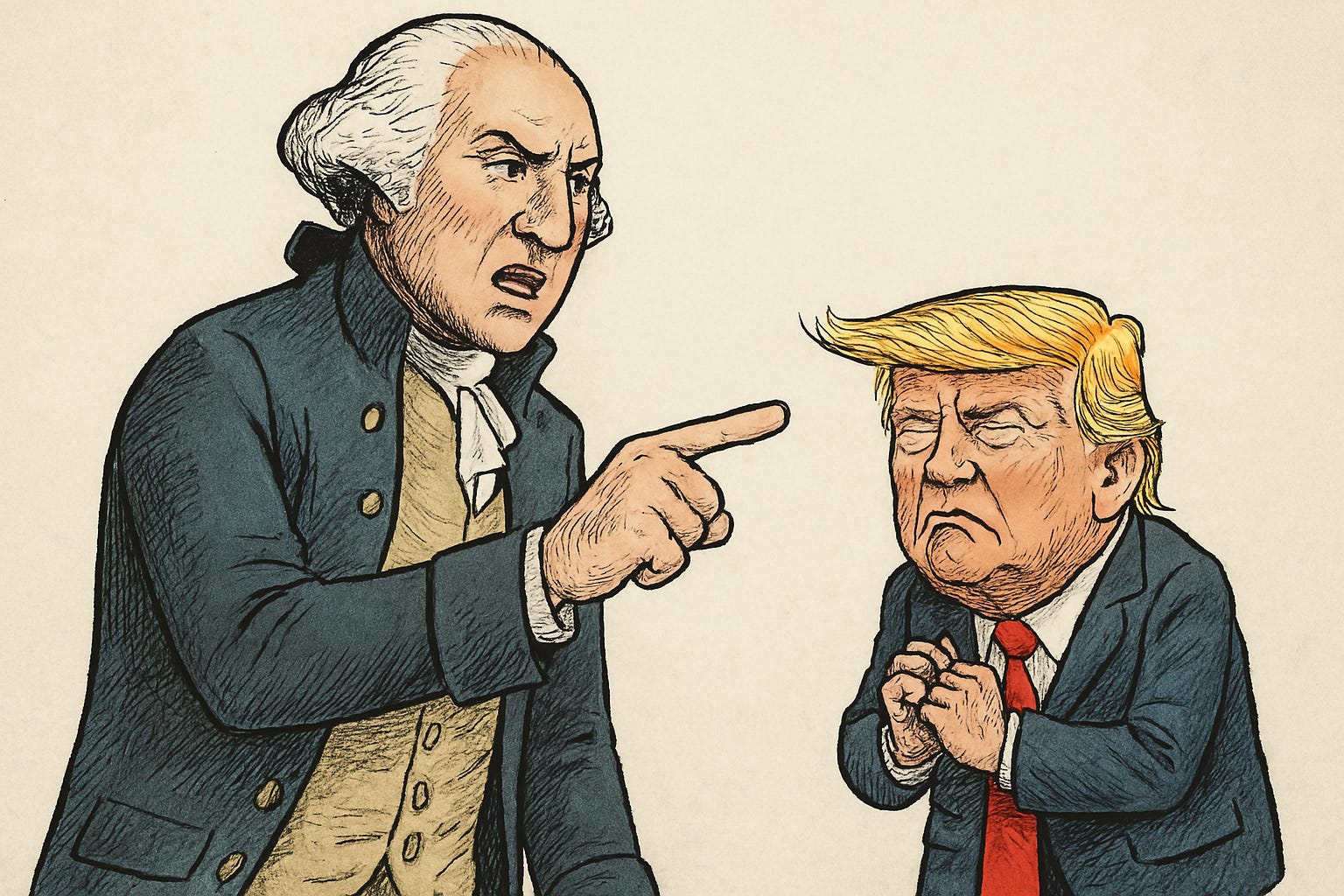
Aperiodically, George Washington’s Farewell Address has been read aloud in the United States Senate and the U. S. House of Representatives. The purpose has been to remind Congressional lawmakers of their obligation to uphold the Constitution against all individuals, organizations, or institutions intent on:
Violating any article of or amendment to the Constitution.
Undermining the Federal Government defined by the Constitution.
This year a bill1 was introduced in the US House of Representatives to make the reading of Washington’s Farewell Address mandatory.
If the 546 members of the three branches of the United States Federal Government consistently adhered to Washington’s counsel, America would not be in the dire situation it now finds itself.
Washington feared and predicted the worst-case political and economic scenarios the United States might face in the future.
228 years later in 2025, the United States is now concurrently experiencing many of the worst-case scenarios Washington feared could happen.
Introduction
In 1796 George Washington published his farewell address to the nation. In his address, George Washington counseled and admonished the American People and their government representatives, present and future, on how to protect their Constitution and the Federal Government structure defined by the Constitution. He feared that internal divisiveness and corruption, foreign intrigue would undermine, control, or destroy the unity of government.
Link to full text of: George Washington's Farewell Address
George Washington warned against geographical sectionalism, partisan political parties and factions, interference by foreign nations, and corrupt entities and individuals.
He encouraged, promoted, and touted the importance of religion, virtue, morals, ethics, and the education of the voting public to preserve the Constitution and the unity of government.
George Washington’s Wish for the American People
"… that your union and brotherly affection may be perpetual; that the free constitution, which is the work of your hands, may be sacredly maintained; that its administration in every department may be stamped with wisdom and virtue; that, in fine, the happiness of the people of these states, under the auspices of liberty, may be made complete by so careful a preservation and so prudent a use of this blessing …"
After declaring his wish for the American people, Washington began his counsel on how to preserve the union of the 13 states and sustain the integrity of the Constitution and the government it defined.
Preservation of the Union
Washington's overarching concern was preserving the recently formed union of the thirteen states united by the Constitution.
"The unity of government which constitutes you one people is also now dear to you. It is justly so; for it is a main pillar in the edifice of your real independence, the support of your tranquility at home, your peace abroad, of your safety, of your prosperity, of that very liberty which you so highly prize."
Washington warned the People of the sources and causes that might seek to undermine and fracture the unity of America’s government which he believed underpins America's strength and the happiness of its people.
"… it is easy to foresee that, from different causes and from different quarters, much pains will be taken, many artifices employed, to weaken in your minds the conviction of this truth; as this is the point in your political fortress against which the batteries of internal and external enemies will be most constantly and actively (though often covertly and insidiously) directed"
Washington understood that the people's belief in a unified government is what makes America great.
"… you should properly estimate the immense value of your national Union to your collective and individual happiness; that you should cherish a cordial, habitual, and immovable attachment to it; accustoming yourselves to think and speak of it as of the palladium of your political safety and prosperity; watching for its preservation with jealous anxiety; discountenancing whatever may suggest even a suspicion that it can in any event be abandoned; and indignantly frowning upon the first dawning of every attempt to alienate any portion of our country from the rest, or to enfeeble the sacred ties which now link together the various parts."
"The name of American, which belongs to you in your national capacity, must always exalt the just pride of patriotism more than any appellation derived from local discriminations. With slight shades of difference, you have the same religion, manners, habits, and political principles. You have in a common cause fought and triumphed together. The independence and liberty you possess are the work of joint councils and joint efforts—of common dangers, sufferings, and successes."
" . . . in union, all the parts combined cannot fail to find in the united mass of means and efforts greater strength, greater resource, proportionably greater security from external danger, a less frequent interruption of their peace by foreign nations:"
"… your Union ought to be considered as a main prop of your liberty, and that the love of the one ought to endear to you the preservation of the other.
These considerations speak a persuasive language to every reflecting and virtuous mind and exhibit the continuance of the Union as a primary object of patriotic desire."
Geographical Discrimination
Washington defined how politicians misrepresent the beliefs and intents of one geographical section of the country over another, designed to weaken the public trust in the federal government.
" . . . characterizing parties by geographical discriminations—northern and southern—Atlantic and western; whence designing men may endeavor to excite a belief that there is a real difference of local interests and views. One of the expedients of party to acquire influence within particular districts is to misrepresent the opinions and aims of other districts. You cannot shield yourselves too much against the jealousies and heart burnings which spring from these misrepresentations. They tend to render alien to each other those who ought to be bound together by fraternal affection."
Based on the governing experience under the Articles of Confederation, Washington knew that bilateral or multilateral interstate agreements should be avoided. The Federal Government should control interstate agreements.
"To the efficacy and permanency of your Union, a government for the whole is indispensable. No alliances, however strict, between the parts can be an adequate substitute. They must inevitably experience the infractions and interruptions which all alliances in all times have experienced."
The Constitution and Its Amendments
Washington praised the Constitution and compared it to the Articles of Confederation, which it replaced.
" … you have improved upon your first essay by the adoption of a Constitution of government better calculated than your former for an intimate Union and for the efficacious management of your common concerns."
Washington reminded the people that they must sacredly obey all the articles of the Constitution until they are changed through the amendment process.
" … containing within itself a provision for its own amendment, has a just claim to your confidence and your support. Respect for its authority, compliance with its laws, acquiescence in its measures, are duties enjoined by the fundamental maxims of true liberty. The basis of our political systems is the right of the people to make and to alter their constitutions of government. But the Constitution which at any time exists, until changed by an explicit and authentic act of the whole people, is sacredly obligatory upon all. The very idea of the power and the right of the people to establish government presupposes the duty of every individual to obey the established government."
"If in the opinion of the people the distribution or modification of the constitutional powers be in any particular wrong, let it be corrected by an amendment in the way which the Constitution designates."
" … let there be no change by usurpation; for though this, in one instance, may be the instrument of good, it is the customary weapon by which free governments are destroyed."
The Need for a Strong Federal Government
Washington believed a strong federal government was necessary for the United States to survive.
"To the efficacy and permanency of your Union, a government for the whole is indispensable."
Two hundred twenty-eight years ago, Washington predicted what would happen if a faction (e.g. MAGA Republicans in 2025) obstructed the execution of laws, disrupted the lawful functioning of government agencies, and ignored the Constitution.
"Towards the preservation of your government and the permanency of your present happy state, it is requisite not only that you steadily discountenance irregular oppositions to its acknowledged authority but also that you resist with care the spirit of innovation upon its principles, however specious the pretexts. One method of assault may be to effect in the forms of the Constitution alterations which will impair the energy of the system and thus to undermine what cannot be directly overthrown. In all the changes to which you may be invited, remember that time and habit are at least as necessary to fix the true character of governments as of other human institutions, that experience is the surest standard by which to test the real tendency of the existing constitution of a country, … "
Washington believed that the Federal government should be strong but not strong enough to curtail any American citizen’s rights as defined in the Constitution and its Amendments.
" … for the efficient management of your common interests in a country so extensive as ours, a government of as much vigor as is consistent with the perfect security of liberty is indispensable; liberty itself will find in such a government, with powers properly distributed and adjusted, its surest guardian."
Political Parties (Factions)
Washington knew the creation and evolution political parties and factions was regrettable, but inevitable. He feared that alternate domination of the Federal Government by one party over all others would likely lead to despotism.
"One of the expedients of party to acquire influence within particular districts is to misrepresent the opinions and aims of other districts."
" … alternate domination of one faction over another, sharpened by the spirit of revenge natural to party dissension, which in different ages and countries has perpetrated the most horrid enormities, is itself a frightful despotism. But this leads at length to a more formal and permanent despotism. The disorders and miseries which result gradually incline the minds of men to seek security and repose in the absolute power of an individual; and sooner or later the chief of some prevailing faction, more able or more fortunate than his competitors, turns this disposition to the purposes of his own elevation on the ruins of public liberty."
" … the common and continual mischiefs of the spirit of party are sufficient to make it the interest and the duty of a wise people to discourage and restrain it."
" … distract the public councils and enfeeble the public administration. It agitates the community with ill founded jealousies and false alarms, kindles the animosity of one part against another, foments occasionally riot and insurrection. It opens the door to foreign influence and corruption, which find a facilitated access to the government itself through the channels of party passions. Thus the policy and the will of one country are subjected to the policy and will of another."
Washington believed that when members of a political party or faction control the Federal Government and exceed the authority granted to them by the Constitution, then American citizens must protest and demand that any usurpation of power be reversed.
" … there being constant danger of excess, the effort ought to be by force of public opinion to mitigate and assuage it. A fire not to be quenched, it demands a uniform vigilance to prevent its bursting into a flame, lest instead of warming it should consume."
To avoid drifting towards despotism, Washington recognized that the balance of powers granted by the Constitution to the executive, legislative, and judicial branches of the Federal Government must be maintained and not be encroached upon by any branch.
" … the habits of thinking in a free country should inspire caution in those entrusted with its administration to confine themselves within their respective constitutional spheres, avoiding in the exercise of the powers of one department to encroach upon another. The spirit of encroachment tends to consolidate the powers of all the departments in one and thus to create, whatever the form of government, a real despotism."
Religion, Virtue, Morals and Ethics
Washington was a religious man.
"Of all the dispositions and habits which lead to political prosperity, religion and morality are indispensable supports."
"Whatever may be conceded to the influence of refined education on minds of peculiar structure, reason and experience both forbid us to expect that national morality can prevail in exclusion of religious principle."
" … true that virtue or morality is a necessary spring of popular government."
Education of the People
"Promote then, as an object of primary importance, institutions for the general diffusion of knowledge."
"it is essential that public opinion should be enlightened."
Taxation
" … bear in mind that towards the payment of debts there must be revenue; that to have revenue there must be taxes; that no taxes can be devised which are not more or less inconvenient and unpleasant;"
Foreign Relations
Based on the political and military history of the late 18th century, it is understandable that Washington would prefer for the United States to be both politically and economically neutral. This belief appears to influence most of his advice and counsel on foreign affairs.
"Observe good faith and justice towards all nations; cultivate peace and harmony with all;"
" … permanent, inveterate antipathies against particular nations and passionate attachments for others should be excluded and that in place of them just and amicable feelings towards all should be cultivated. The nation which indulges towards another an habitual hatred, or an habitual fondness, is in some degree a slave."
"Antipathy in one nation against another disposes each more readily to offer insult and injury, to lay hold of slight causes of umbrage, and to be haughty and intractable when accidental or trifling occasions of dispute occur."
"The nation, prompted by ill will and resentment, sometimes impels to war the government, contrary to the best calculations of policy. The government sometimes participates in the national propensity and adopts through passion what reason would reject; at other times, it makes the animosity of the nation subservient to projects of hostility instigated by pride, ambition and other sinister and pernicious motives."
"passionate attachment of one nation for another produces a variety of evils. Sympathy for the favorite nation, facilitating the illusion of an imaginary common interest in cases where no real common interest exists and infusing into one the enmities of the other, betrays the former into a participation in the quarrels and wars of the latter, without adequate inducement or justification."
Washington was clearly against the use of Tariffs.
" … concessions to the favorite nation of privileges denied to others, which is apt doubly to injure the nation making the concessions, by unnecessarily parting with what ought to have been retained and by exciting jealousy, ill will, and a disposition to retaliate in the parties from whom equal privileges are withheld. And it gives to ambitious, corrupted, or deluded citizens (who devote themselves to the favorite nation) facility to betray or sacrifice the interests of their own country without odium, sometimes even with popularity, gilding with the appearances of a virtuous sense of obligation, a commendable deference for public opinion, or a laudable zeal for public good, the base or foolish compliances of ambition, corruption, or infatuation."
" … avenues to foreign influence in innumerable ways, such attachments are particularly alarming to the truly enlightened and independent patriot. How many opportunities do they afford to tamper with domestic factions, to practice the arts of seduction, to mislead public opinion, to influence or awe the public councils! Such an attachment of a small or weak towards a great and powerful nation dooms the former to be the satellite of the latter."
" … foreign influence is one of the most baneful foes of republican government."
"Excessive partiality for one foreign nation and excessive dislike of another cause those whom they actuate to see danger only on one side, and serve to veil and even second the arts of influence on the other. Real patriots, who may resist the intrigues of the favorite, are liable to become suspected and odious, while its tools and dupes usurp the applause and confidence of the people to surrender their interests."
"The great rule of conduct for us in regard to foreign nations is, in extending our commercial relations, to have with them as little political connection as possible.''
" … steer clear of permanent alliances with any portion of the foreign world …"
"Harmony, liberal intercourse with all nations, are recommended by policy, humanity, and interest.''
George Washington would disagree with deploying any form of tariff.
" … our commercial policy should hold an equal and impartial hand: neither seeking nor granting exclusive favors or preferences; consulting the natural course of things; diffusing and diversifying by gentle means the streams of commerce but forcing nothing; establishing with powers so disposed—in order to give to trade a stable course, to define the rights of our merchants, and to enable the government to support them … "
Conclusions
The Trump 2.0 administration’s executive actions during its first 100 days in power exhibit most, if not all, of George Washington’s concerns and fears regarding despotic actions which could, if not checked, erode the Federal Government structure defined by the Constitution by:
Taking unintended advantage of congress’ delegation to the President of its sole power to create tariffs as defined by Article I, Section 8 and Article I, Section 10, Clause 2 of the Constitution.
Violating the writ of habeus corpus as defined in the Suspension Clause of the Constitution (Article I, Section 9, Clause 2) of the Constitution and as clarified and modified in subsequent judicial rulings and state laws.
Effectively eliminating government departments and agencies created by Congress’ laws through employee terminations and the cancellation of programs, projects, and grants previously legislated by Congress.
Ignoring the rule of law by ignoring federal court and the Supreme Court rulings in cases, such as the illegal deportation of Kilmar Armando Abrego Garcia.
Applying existing laws to situations for which they were not originally intended (e.g. using the 1798 “Act Concerning Aliens” to deport certain immigrant cohorts).
if Congress and the Federal Courts do not bring the Trump 2.0 Presidency “to heel”, then the American People must take direct action through their votes and high visibiity protests.
H.Con.Res.13 - Providing that George Washington's "Farewell Address" shall be read at the beginning of each Congress. 119th Congress (2025-2026)